AI for Inclusion: Leveling the Playing Field
#digitalproficiencyai
#talentmanagement
#inclusion



When the AI wave hit, we weren’t starting from zero. The foundations were already in place. Handing people a powerful tool and trusting them to run with it sounds empowering. In practice, it can quietly create a divide. Within a couple of months, three patterns emerged: a confident group raced ahead, a large middle hesitated, and many carried on as before. Left alone, the divide becomes a capability gap and eventually an opportunity gap.
Our biggest shift has been in how we teach, shifting from generic ‘how to prompt’ sessions to rebuilding learning around real problems people actually face: use-case centric training, small and frequent skill labs, peer sharing, reverse mentoring (AI-fluent juniors coaching senior leaders), a named Chief AI Officer, and bold experimentation inside a safe, governed environment.
90% of EY people are trained on AI basics. From potential to scale in 12 months, experimentation is now execution. Quality and clarity of outputs are rising, narrowing the gap between ‘AI natives’ and colleagues who previously held back.
This Best Practice is part of the Gender Intelligence Report 2026.
Our Journey | AI as a strategic priority
When the AI wave hit, we weren’t starting from zero. Two foundations were already in place:
Strategy set. Tools in every hand. What remained was sustainable adoption and how we work.
Where equal access stops and adoption begins
Handing people a powerful tool and trusting them to run with it sounds empowering. In practice, it can quietly create a divide.
Some people love innovation and change, to deep-dive, tinker and self-teach. Others don’t. Not because they can’t, but because that’s not how they learn or where they want to spend their energy.
“All talent in our firm, from the most junior to the most senior, need to work with AI. When organizations ensure equal access to tools, learning and real application, we have a big opportunity to help our people thrive and accelerate progress on topics like the gender gap.”
Jennifer Mathias, Chief Talent Officer, EY Switzerland
Within a couple of months, three interesting patterns emerged:
There is a gender dimension to these patterns as well.
Research confirms that globally, 47.8% of men use generative AI compared to 39.3% of women. At work, women are 22% less likely than men to be regular AI users and are 32% more likely to fear being seen as “cheating.” 1,2
Left alone, this divide becomes a capability gap and eventually an opportunity gap.
The goal was to move from equal access to equal adoption, ensuring that every employee, regardless of how they learn or where they sit in the organisation, can and does work with AI in daily work, and to ensure that the adoption model actively closes the gap rather than widens it.
Our biggest shift has been in how we teach. We are shifting from generic “how to prompt” sessions and rebuilding learning around real problems people actually face:
“Stop teaching people how to prompt. Instead, solve their real business problems with them, because that’s what makes AI feel relevant and leveraged. Encourage them to keep trying, since what didn’t work yesterday often works today. And run small, frequent skill labs rather than one perfect training. They keep pace with rapid advancement, build momentum and let people learn from each other.”
Adrian Ott, Chief AI Officer, EY Switzerland
Why this matters for women
AI democratizes knowledge. People are now less dependent on pedigree, education or years of experience, and more able to contribute based on judgment, curiosity and purpose. That shift disproportionately benefits people previously held back by structural or confidence barriers.
Specifically, AI helps level the playing field for women in three ways:
AI democratizes knowledge. People are now less dependent on pedigree, education or years of experience, and more able to contribute based on judgment, curiosity and purpose. That shift disproportionately benefits people previously held back by structural or confidence barriers.
Specifically, AI helps level the playing field for women in three ways:
Research shows women often step forward only when they feel fully qualified. AI turns “I’m not sure I can” into “I can try”, and that translates into bolder career moves, because it helps to learn faster, solve problems more efficiently, and contribute more confidently.
Supports reskilling after career breaks, enables less biased talent decisions when designed well, and frees time for leadership work.
As AI takes over routine tasks, value moves to skills like empathy, collaboration and developing others – areas where research shows women often score highly.
Our message: AI is a powerful equalizer and a powerful amplifier of inequality. Which one it becomes is a leadership choice.
Our recipe: a strong foundation of long-term investment and clear leadership commitment and expectations, equal access to the same tools for everyone, and an adoption model built on real business use cases, peer sharing and psychological safety.
Done well, AI does what we believe it should: level the playing field, and make our smart people smarter.
Sources:
[1] Global Evidence on Gender Gaps and Generative AI Over Time; Cranney, Delecourt, Koning; HBS Working Paper 25-023, revised May 2026
[2] The Gender Gap In AI Use – And What’s Driving It, According To Lean In Survey; Kim Elsesser; 2026
[3] Jack Zenger and Joseph Folkman, “Women Score Higher Than Men in Most Leadership Skills,” Harvard Business Review, June 25, 2019.
For more information about this Best Practice, reach out to the author:
Margit Vunder
Culture and Inclusiveness, Talent Team, EY
margit.vunder@ch.ey.com

If CEOs are value-driven they make Diversity, Equity, and Inclusion a strategic focus area. By trusting and supporting their leaders to authentically champion these initiatives, the organization is able to foster a positive culture, improve performance, and achieve success.
When leaders are empowered to pursue their beliefs and values, they can lead with authenticity, integrity, and purpose, resulting in positive impacts on the organization.

Learn how Swiss Re is enabling leaders to incorporate inclusion into daily practice and to foster an inclusive environment where everyone feels valued.
Syngenta's Female Sponsorship Program is aimed at building a solid pipeline of female tech leaders within the company and the industry. Through tailored connections, support for global relocations, and tangible career advancements, the program has already made a noticeable impact on the careers of 18 talented women.

How can you push gender equality in the right direction at a faster pace? At Bain, a sponsorship program is key for ensuring the top management pipeline and retaining female leaders.

SIX launches SPI Gender Equality Index for Switzerland, aligning their core business activities with their D&I Strategy.

48% of all PM Switzerland’s management level employees were women in 2020, smashing the target of 40% by end 2022.

Dow's Sponsorship Program is de-biased by self-nomination and busts the myth that 'there are no eligible women'

Change doesn’t happen overnight but by integrating top & grassroots initiatives @Citi successfully builds an inclusive culture.

"NextWave” holds leaders accountable for creating and embedding an inclusive culture.
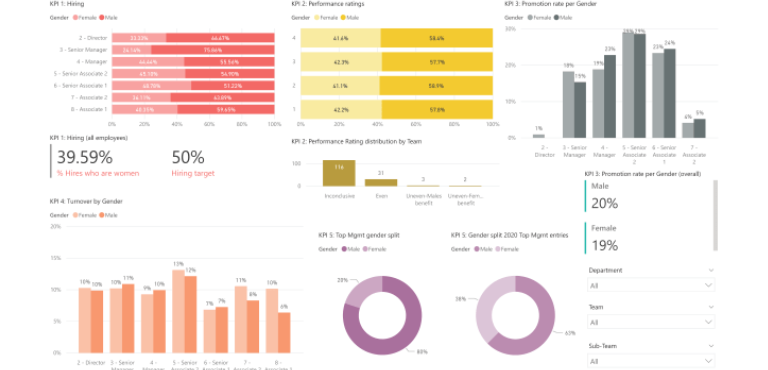
A highly effective way to increase transparency: a Dashboard provides real time D&I analytics helping to get leaders’ buy-in for action.
The CEO and senior leaders publicly advocate diversity and inclusion as business imperative.

Eye-opening sessions for male leaders to understand the challenges that women face in their careers.